> The dinosaur footprint <
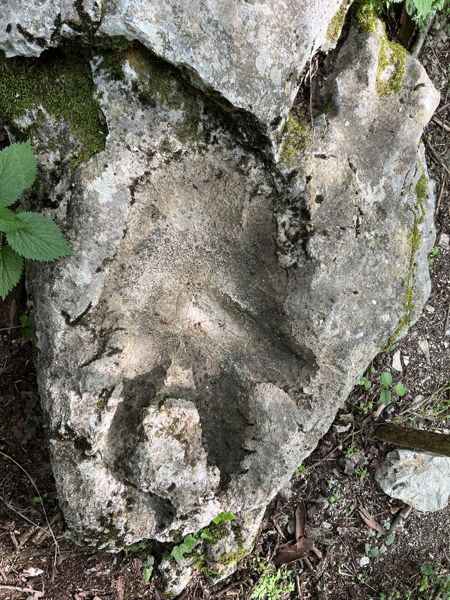
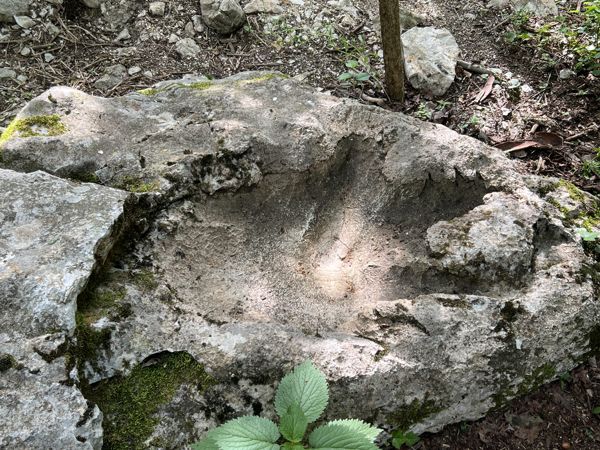
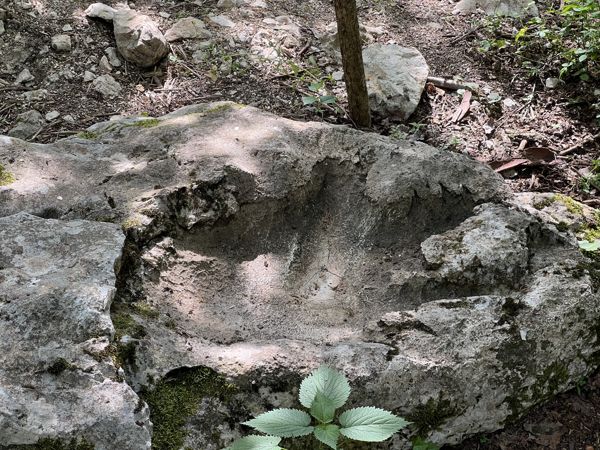
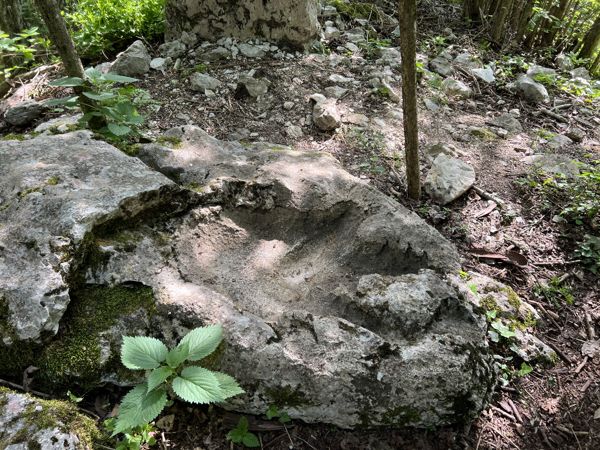
Beppino, the second footprint of the Cansiglio
> Beppino, the dinosaur’s footprint <
Dinosaur footprints are relatively rare in Italy, so much so that none had ever been found until 1985. The book Geosites of Friuli Venezia Giulia states that in the Friulian Dolomites, particularly in the municipalities of Claut, Cimolais, and Andreis, a dozen boulders containing fossilized dinosaur and other terrestrial tetrapod footprints are known. All are in Main Dolomite, a sedimentary rock originating from carbonate muds and sands deposited in a tidal flat environment. Following the discovery of the Casera Casavento footprints between 1994 and 1996, numerous boulders with footprints were found by Mauro Caldana of Cordenons, who continued to find new palaeo-ichnological finds thereafter.
Depending on the shape of their pelvis, dinosaurs are divided into Saurischians (with a reptilian pelvis, or rather “lizard pelvis”, from the Greek “sáuros” meaning lizard and “ischíon”, pelvis) and Ornithischians (with a bird pelvis, from the Greek ornithòs). Saurischians include Theropods (predatory carnivores such as Tyrannosaurus rex, Allosaurus, and Velociraptor) and Sauropodomorphs (the herbivores such as Apatosaurus or the Diplodocus-like Brachiosaurus which walked on all-fours). The former included both very large animals and smaller, more agile species. Sauropodomorphs reached considerable dimensions. Ornithischians, on the other hand like Triceratops and duck-billed dinosaurs, equipped with spines, armour, and quills to defend themselves from predators, were all herbivorous. Worldwide, large Triassic “theropod” dinosaur tracks are rare. They are a suborder of fossil reptiles in the order Saurischia, gigantic bipeds with short forelimbs and clawed toes, and a long, robust tail, which served for balance. They represented a large portion of the dominant carnivores in the Mesozoic Era.
In the Carnic Prealps, there are two easily accessible sites with dinosaur tracks (ichnofossils), one in Claut and one in Polcenigo. These tracks are imprinted on loose and rolled rocks, so the tracks are located higher up than the site.Near Casera Casavento, below the waterfall, is a pair of theropod dinosaur prints from the Late Triassic, one of which is intact, well-preserved, and approximately 35 centimetres in length. It was a rather large animal, a sort of large chicken, with an estimated height at the hip of 140-176 cm. The site was discovered by chance by Giampaolo Borsetto in 1994 while filling a water bottle.
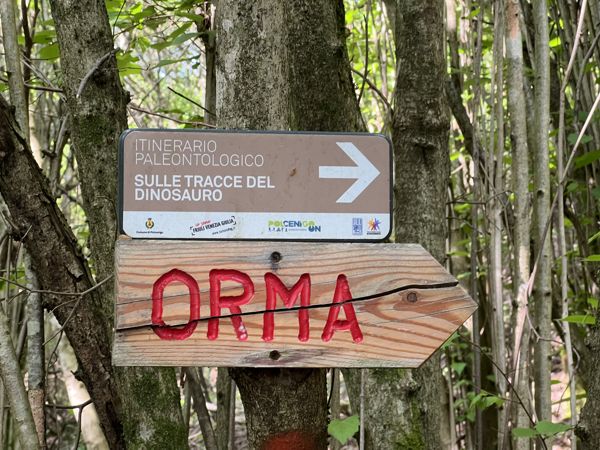
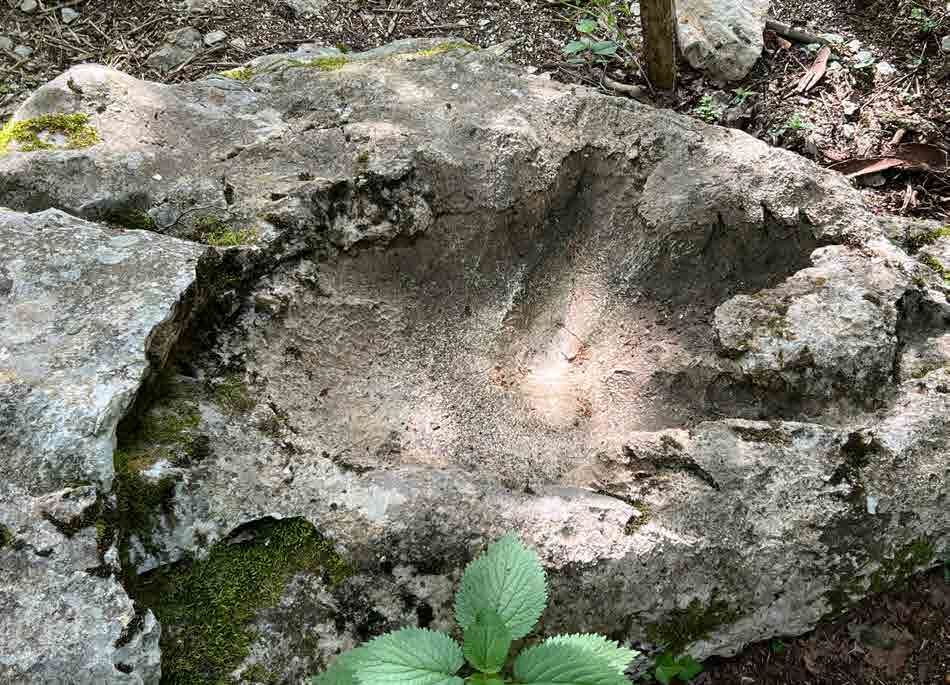
In 2018, an equally chance find by Giuseppe Minatelli caught the attention of enthusiasts in Polcenigo: on a block of limestone in the woods, he found a dinosaur footprint (later named “Beppino” in honour of its discoverer), attributed to a theropod from the Cretaceous period (about 130 million years ago, thus more recent than the Casavento dinosaur) that, with its bipedal gait, roamed the ancient landmass. Around 170 million years ago, the Cansiglio – Cavallo area was submerged by an ocean, known as the Ligurian-Piedmont Ocean, up to 3,000 metres deep and dotted with underwater platforms and emergent land. In some areas, tropical reefs similar to those found in the modern-day Maldives supported lush coral reefs. Subsequently, with the slow and inexorable movement of the plates, that ocean disappeared and the mountains as we know them today took shape, providing us with evidence of that past. This is not the first footprint found in limestone in this part of the Cansiglio, for in 1994, during work on the Porto Corsini pier in the Marina of Ravenna in Emilia Romagna a Friulian geologist, Sandro Venturini, identified tracks on one of the blocks used to construct the piers at the entrance to the port. The following year, the block, weighing approximately 6,000 kilograms, was placed in the botanical garden of the Civic Museum of Natural History in Faenza.
Videos and documentaries
Video stories and mini documentaries filmed on site.
Images · The dinosaur footprint
6 photos · Photo Divulgando Srl · May 2025. Tap a photo to enlarge it.