> Bus de la Lum <
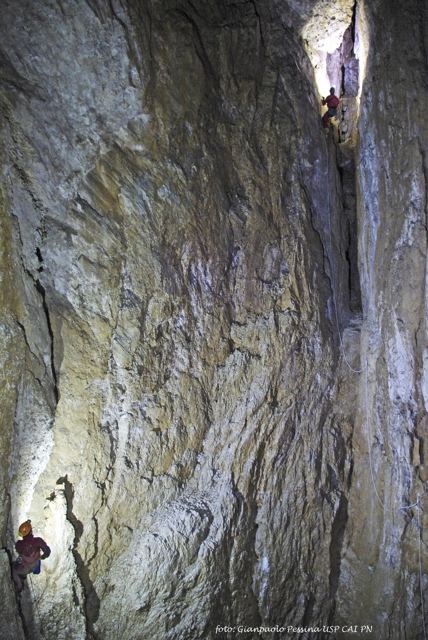
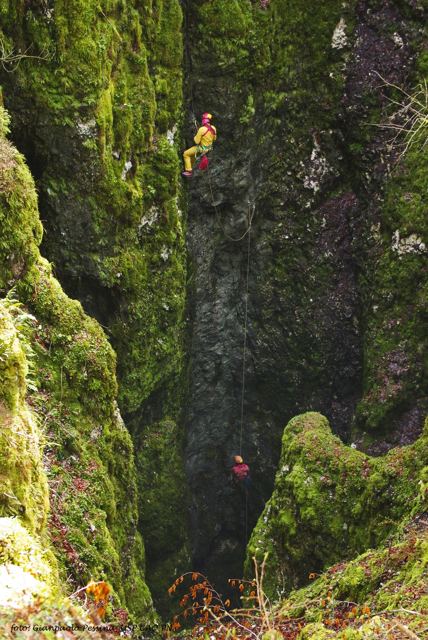
The great elliptical funnel among the forest trees: an abyss of almost 200 m linked to legends, to the history of caving and to the events of the Second World War.
Connected since 1981 to the Pozzo dei Bellunesi (3506): the Bus de la Lum – Bellunesi complex has a height difference of 186 m, from the Bellunesi entrance (1040 m) to the bottom of the Bus de la Lum (854 m a.s.l.).
From the guide
The Bus de la Lum opens at an altitude of 1,030 metres a.s.l. in the Friulian part of the basin, forming a wide, elliptical funnel among the tall trees of the forest. The name “Lum” (“light”) derives from ancient legends that told of flames spotted near the chasm, attributed to fantastic creatures or, more realistically, to will-o’-the-wisps produced by the decomposing carcasses of animals that had fallen into it. It is a vertical cavity 186 metres deep, formed by the union of two abysses, with a planimetric length of 718 metres. One is the main one, now fenced off, which was explored by the Trieste-based C.G.E.B. Trieste in 1924, while the other was discovered by a Belluno-based team in 1981 near the original abyss and was subsequently named the “Pozzo dei Bellunesi”. Initial interest in the Lum began in 1901 when the engineer Luigi Marson launched a sounding line into the chasm, recording a depth of 460 meters. This incorrect estimate made the abyss the deepest in the world, obviously arousing curiosity and interest. This measurement was later reduced to 195 m. At the bottom of the cave, a perennial waterfall is fed by icy waters originating from a narrow gorge-like passage known as the “Ramo dello Scoiattolo”. The stream sinks into the debris deposits and is eventually absorbed within the “Salone della Lanterna”. The Bus de la Lum is a cavity which is historically and sadly notable for events related to the Second World War, when, in the final months of the conflict, soldiers and civilians were thrown into it. At least 28 bodies were recovered in the 1960s and were buried in the Caneva cemetery.
What it looks like
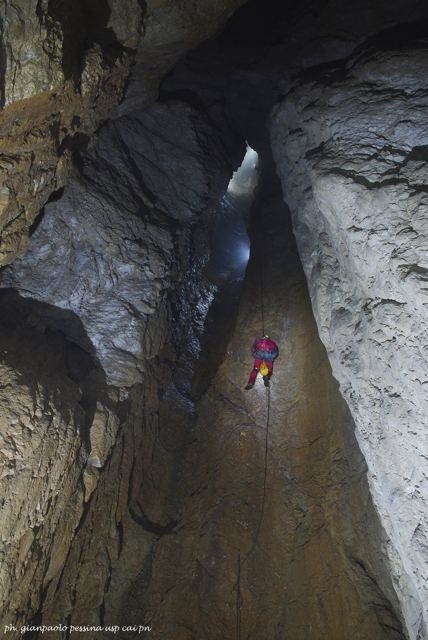
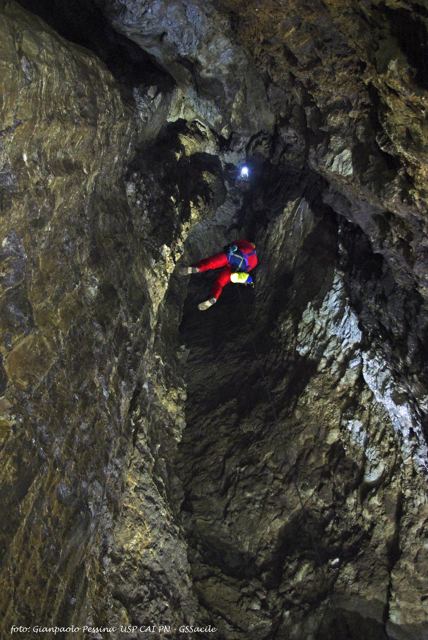
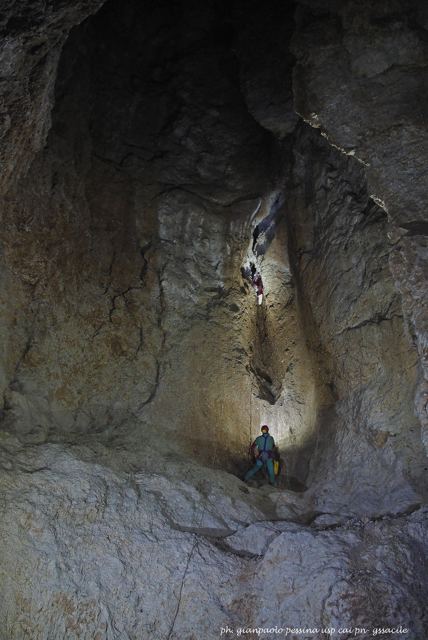
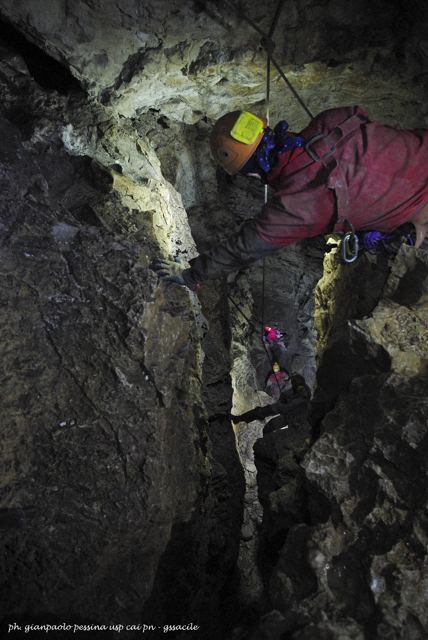
- A single large access shaft of about 175 m, with a debris cone at about 60 m.
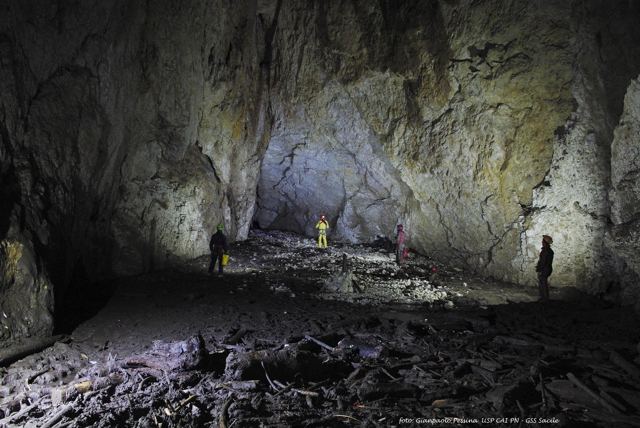
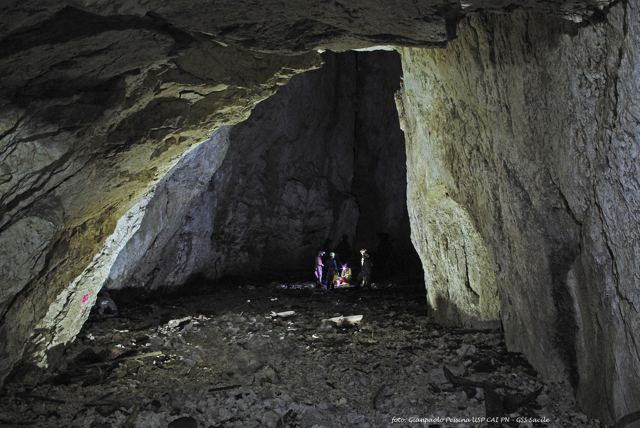
- At the base, a chamber formed along two fractures, connected to the Pozzo dei Bellunesi.
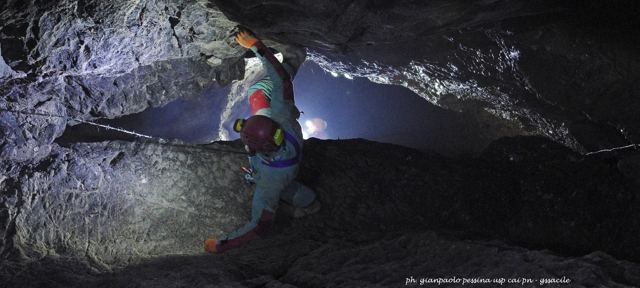
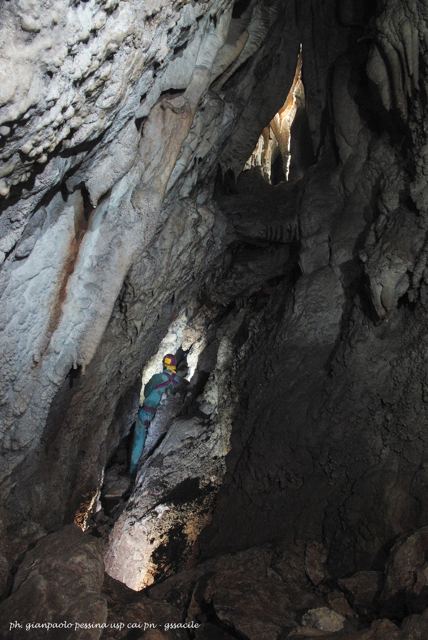
- The Squirrel Branch is a canyon with ups and downs, formations and a perennial waterfall.
- In rainy periods the bottom can flood to more than two metres.
Water and air
From the Squirrel Branch a stream with waterfalls descends, its icy waters disappearing among the debris of the Lantern Hall.
It is listed as a site of archaeological and palaeontological interest; 20th-century history also makes it a place of remembrance.
History of the explorations
- 1901-02
Engineer L. Marson lowers a sounding line and estimates 460 m: for a short time it is thought to be the deepest abyss in the world
- 1904
New sounding by the Circolo Speleologico Idrologico Friulano
- 1924
The Commissione Grotte of the Alpina delle Giulie reaches the bottom
- 1951
Recovery of the bodies of Second World War victims
- 1981
Connection with the Pozzo dei Bellunesi
- 1992-93
Digging by Gruppo Solve (CAI Belluno) and discovery of the Squirrel Branch
- 2004
Survey of the branch (CGEB and Solve)
- 2021
Survey update (F. Felici, GS Sacile)
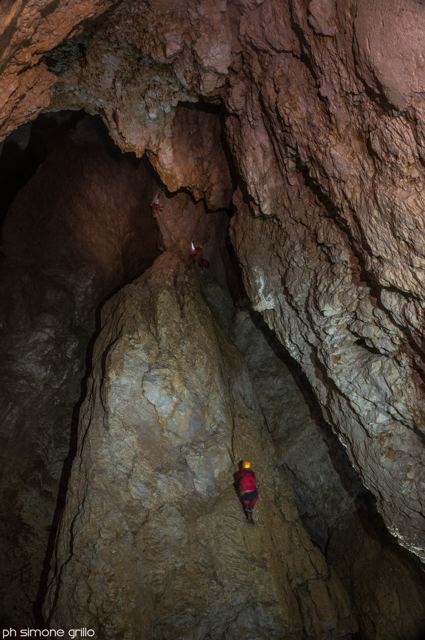
Inside Bus de la Lum
11 photos · Photo Pessina, Photo Pessina – USP, Photo Simone Grillo. Tap a photo to enlarge it.